High Power Microwave Technology: An Invisible Countermeasure to Drones
High-power microwave (HPM) systems offer distinct advantages in countering low-altitude, slow-speed, and small (LSS) drones, particularly when addressing drone swarms. Their potential role on future battlefields is significant. These systems use powerful electromagnetic pulses to interfere with or damage a target’s internal electronic systems. Depending on the effect, this can result in soft kill outcomes, such as disruption or temporary disablement, or hard kill outcomes, such as permanent electronic damage. What exactly are microwaves? What are their key properties, and how can high-power microwave energy affect a drone’s onboard electronics? This article explains the underlying principles.
1 What Are Microwaves?
Microwaves are a type of electromagnetic wave. Electromagnetic waves are oscillating electric and magnetic fields that propagate through space, carrying energy and momentum. They do not require an elastic medium to travel and can propagate through a vacuum. Their speed in a vacuum, denoted by c, is 299,792,458 m/s, commonly approximated as 3 × 10⁸ m/s. Electromagnetic waves are transverse waves: the electric field and magnetic field are perpendicular to the direction of propagation.
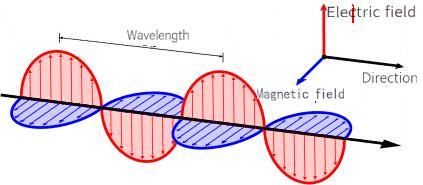
Figure 1. Electromagnetic Wave Amplitude, Wavelength, and Field Components
The number of oscillations of the electric or magnetic field per second is the wave’s frequency. Wavelength is the distance between two adjacent points along the direction of propagation that have the same phase. The relationship between wavelength (λ) and frequency (f) is expressed as c = λf. In other words, wavelength equals propagation speed divided by frequency.
Wavelength helps determine the type and characteristics of an electromagnetic wave. In order of decreasing wavelength and increasing frequency, the electromagnetic spectrum includes long waves, radio waves, microwaves, infrared radiation, visible light, ultraviolet radiation, X-rays, and gamma rays. Microwaves are commonly defined as electromagnetic waves with wavelengths from 1 meter to 1 millimeter, corresponding to frequencies of approximately 300 MHz to 300 GHz. They can be further divided into decimeter, centimeter, and millimeter waves. The term “microwave” reflects their shorter wavelengths compared with longer radio waves.
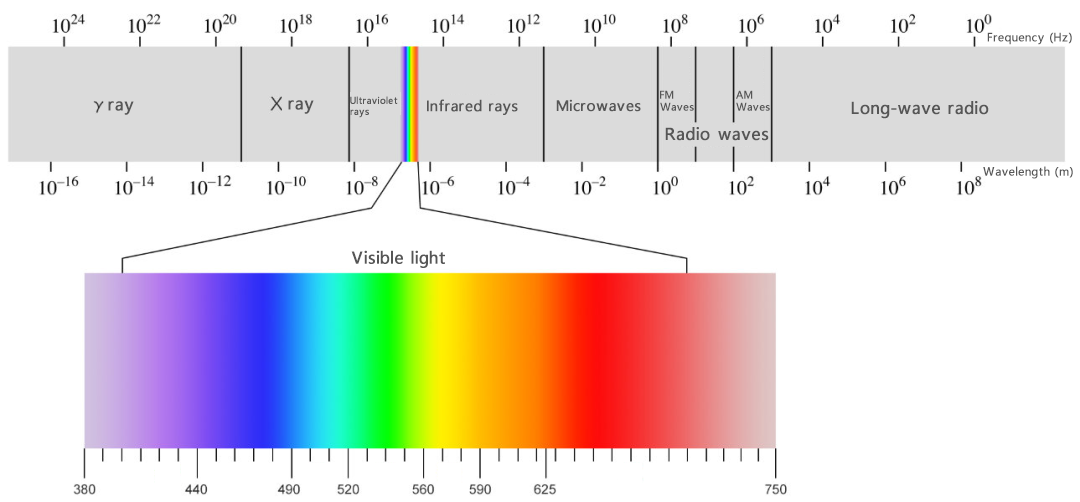
Figure 2. The Electromagnetic Spectrum
2 Microwave Propagation Characteristics
Because of their relatively high frequencies, microwaves offer wide available bandwidth and can support high information capacity. Their distinctive propagation characteristics make them useful in many modern electronic systems. As microwaves propagate, they carry electromagnetic energy and can interact with materials through transmission, reflection, and absorption.
Penetration: Microwaves may pass through certain low-loss insulating materials, such as some ceramics and polypropylene, with relatively little absorption, depending on the material properties and microwave frequency.
Reflection: When microwaves encounter conductive materials such as metal, much of the incident energy can be reflected, in a manner similar to light reflecting from a mirror.
Absorption: Polar materials, including water, can absorb microwave energy and convert it into heat. This is the principle behind microwave ovens.
Compared with infrared radiation, microwaves can penetrate more deeply into some materials. Unlike X-rays and other ionizing radiation, microwaves are non-ionizing and generally do not have enough photon energy to break molecular bonds directly. Microwave technology is therefore used both to transmit information and to deliver energy. Applications include radar sensing, wireless communications, guidance, remote control, remote sensing, and telemetry, as well as industrial and scientific processes such as heating, drying, sterilization, and extraction.
3 What Makes High-Power Microwaves Different?
Frequency and wavelength are two important parameters of electromagnetic waves. To understand what makes a microwave a high-power microwave, we must also consider power. Power is the rate at which energy is transferred, typically measured in watts, and indicates how much electromagnetic energy is delivered per unit of time.
High-power microwave (HPM) usually refers to microwave emissions with very high peak power. In some definitions and applications, HPM systems operate at peak powers above 100 megawatts and across frequencies from approximately 1 GHz to 300 GHz. They are often characterized by high frequency, short pulses—sometimes lasting tens of nanoseconds—and extremely high peak power. HPM is an important form of high-power electromagnetic pulse technology.
Developments in pulsed-power technology during the 1960s and 1970s enabled high-current accelerators to produce electron beams at hundreds of kilovolts and tens of kiloamperes.
These advances opened new possibilities for conventional vacuum-electronic microwave devices and for generating high-power microwaves through beam–wave interactions. Related research in relativistic electronics and plasma physics provided further theoretical foundations. Since then, a range of high-peak-power microwave sources has been developed, supporting applications in electronic engineering, scientific observation, imaging, and other fields.
4 High-Power Microwave Systems on the Battlefield
High-power microwave weapons are a type of directed-energy radio-frequency weapon. They use directed electromagnetic pulses with peak power above 100 megawatts—often in the gigawatt range—to disrupt, degrade, or damage targets.
In a typical system, a high-power microwave source generates microwave energy, which is radiated by a high-gain directional antenna. The antenna concentrates the energy into a narrow, directional beam that travels at the speed of light and illuminates the target with high intensity. The resulting electromagnetic energy can interfere with or damage electronic equipment. This capability has led to the use of HPM technology in counter-unmanned aircraft systems (C-UAS). Its potential area-effect capability may also allow a system to engage multiple drones within a coverage area, making it relevant to countering coordinated drone swarms.
5 How Can High-Power Microwaves Affect a Drone’s Electronics?
A drone’s antennas act as interfaces for receiving and transmitting electromagnetic signals, including communications and navigation signals. When high-power microwave energy enters through an antenna path—particularly when its frequency overlaps with or is close to the operating band of the target system—the process is known as front-door coupling. The coupled energy can interfere with intended signals, causing distortion, increased bit-error rates, or degraded electronic performance. Under sufficiently intense exposure, it may also damage sensitive components.
Drones also contain cables, connectors, apertures, seams, and other openings required for power, communication, and thermal management. These structures can provide unintended paths for electromagnetic energy to enter the enclosure, a mechanism known as back-door coupling. HPM exposure may induce transient voltages or currents on cables and other conductive structures. In addition, reflections from the enclosure and internal components can create complex electromagnetic field patterns inside the drone, inducing currents and voltages in circuit boards, wires, and other electronic structures and potentially affecting normal operation.
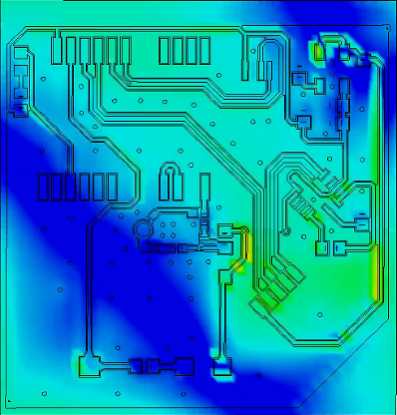
Figure 3. Electric-Field Distribution on a Circuit Board Under High-Power Microwave Exposure
6 Potential Effects of High-Power Microwaves on Drones
Once high-power microwave energy couples into a drone through front-door or back-door paths, it may affect onboard electronic equipment in several ways. Strong electromagnetic fields induced on internal metal surfaces or conductors can alter device operation, degrade performance, or, in severe cases, cause electrical breakdown within components. These outcomes are commonly described as field effects or electromagnetic effects.
HPM exposure can also cause thermal effects. Similar to the heating principle used in microwave ovens, absorbed energy or induced currents can generate excessive heat in electronic components and resistive elements, potentially raising temperatures enough to impair performance or damage the hardware.
A further effect is signal interference. Microwave energy coupled into internal signal cables or circuit nodes can act as an unwanted noise source. If the interference is strong enough, it may overwhelm normal signals exchanged between onboard systems and disrupt their operation.
Compared with some other counter-drone approaches, HPM-based counter-UAS systems may offer advantages such as rapid engagement, the potential to affect multiple targets within an area, and lower marginal engagement costs when adequate electrical power is available. These characteristics can be relevant when defending against low-altitude, slow-speed, and small drones, especially coordinated swarm attacks. HPM systems can be integrated onto platforms such as vehicles, ships, and aircraft to support mobility and adapt coverage to operational requirements. Actual effectiveness depends on system design, target characteristics, environmental conditions, and power availability.
ZR Hi-Tech’s high-power RF amplifiers are used in counter-drone and other demanding RF applications. Our product portfolio covers DC to 50 GHz, with output power up to 200 W. Contact us to discuss your application and technical requirements.


Comments
Post a Comment