RF Power Amplifiers for Wireless Communications: A Comprehensive Guide
In today's connected world, wireless communication is everywhere—from smartphones and Wi-Fi networks to 5G base stations and satellite links. Behind the scenes, one critical component makes it all possible: the RF power amplifier. These devices boost radio frequency signals to ensure they travel farther and penetrate obstacles without losing quality.
If you're into electronics, telecommunications, or just curious about how wireless tech works, this guide will break down RF power amplifiers for wireless communications in a straightforward way.

A typical RF power amplifier module—compact yet powerful, with heatsinks for efficient cooling.
What is an RF Power Amplifier?
An RF (Radio Frequency) power amplifier is an electronic device that takes a low-power RF signal and increases its power level significantly. It's usually the final stage in a transmitter chain, driving the antenna to broadcast the signal effectively.
Unlike low-noise amplifiers (which focus on clean signal reception), power amplifiers prioritize output power, efficiency, and linearity while handling high frequencies (often from MHz to GHz).
A basic schematic of an RF power amplifier circuit, showing key components like transistors and matching networks.
The Role in Wireless Communications
In wireless systems, signals start weak after modulation and processing. Without amplification, they'd fade quickly over distance. RF power amplifiers solve this by:
- Enabling long-range transmission in cellular networks
- Supporting high-data-rate applications like 5G and Wi-Fi 6
- Maintaining signal integrity in crowded spectrum environments
- Powering base stations, repeaters, and handheld devices
Modern designs often use advanced materials like GaN (Gallium Nitride) for better efficiency and higher power density compared to traditional silicon-based options.
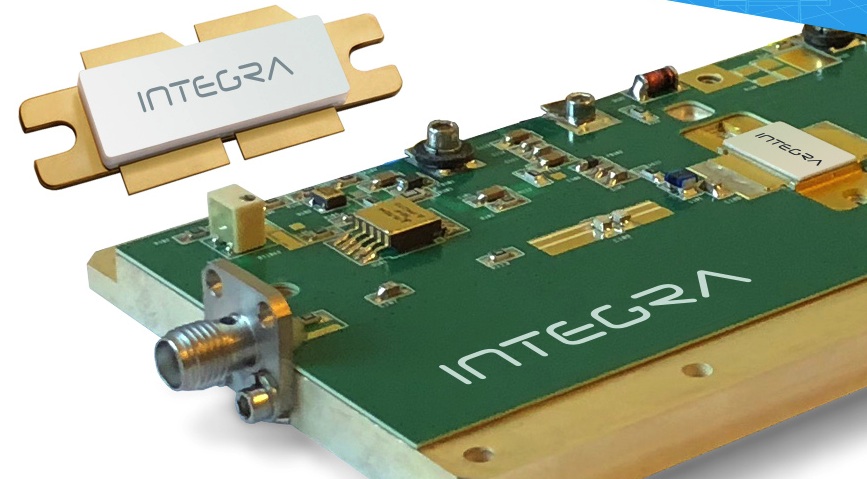
GaN-based RF power transistors deliver superior performance in demanding applications.
Types and Classes of RF Power Amplifiers
RF power amplifiers come in various classes, each trading off efficiency, linearity, and distortion:
- Class A: Highly linear but low efficiency (~25-30%)
- Class AB: Good balance of linearity and efficiency (~50%)
- Class C: High efficiency (>70%) but more distortion—common in non-linear applications
- Class D/E/F: Switching amplifiers with very high efficiency, popular in modern wireless systems
For wireless communications, Class AB and advanced switching classes (like Doherty architectures) are common to meet strict linearity requirements for complex modulations like OFDM.
Key Considerations When Choosing an RF Power Amplifier
When selecting one for your project or system, focus on:
- Frequency range and bandwidth
- Output power (watts or dBm)
- Gain and efficiency
- Linearity (measured by IMD or ACPR)
- Thermal management and size
- Reliability for your application (commercial, aerospace, etc.)
A Recommended Manufacturer: ZR Hi-Tech
If you're looking for high-quality RF power amplifiers, ZR Hi-Tech stands out as a reliable choice. This advanced manufacturer specializes in power amplifiers across various bands, offering custom designs tailored to specific needs. Their products are known for performance in demanding sectors like telecommunications, aerospace, and defense, with a focus on innovation and quality.

Examples of compact, high-performance RF power amplifier modules ready for integration.
Final Thoughts
RF power amplifiers are the unsung heroes of wireless communications, enabling the seamless connectivity we rely on daily. As technology advances toward 6G and beyond, these components will only grow more sophisticated.
If you're working on a wireless project, understanding these basics can help you make informed decisions. Have experience with RF amplifiers? Share your thoughts in the comments!


Comments
Post a Comment