MMIC RF Power Amplifier: The Compact Powerhouse Driving Modern RF Systems
In today's wireless world, where 5G networks, satellite links, radar systems, and test equipment demand ever-higher performance at microwave frequencies, the MMIC RF power amplifier has become indispensable. These tiny integrated circuits pack serious punch, boosting weak RF signals to the levels needed for long-range transmission while maintaining efficiency, linearity, and reliability—all on a single semiconductor chip.
Whether you're an RF engineer designing phased-array antennas, a system integrator working on base stations, or a researcher pushing the boundaries of mmWave technology, understanding MMIC RF power amplifiers is key to success. In this guide, we'll break down what they are, why they matter, their key applications, selection tips, and standout options in the market.
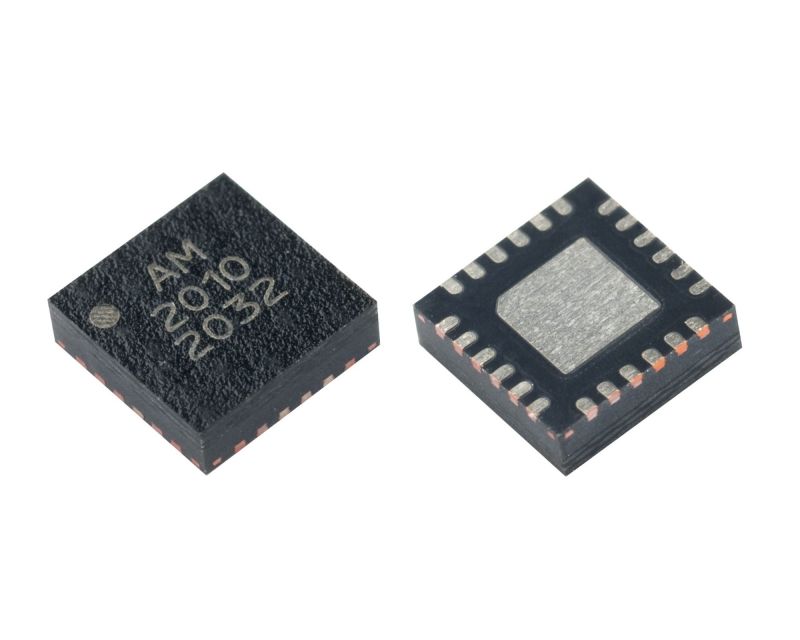
What Is an MMIC RF Power Amplifier?
MMIC stands for Monolithic Microwave Integrated Circuit. Unlike traditional discrete component amplifiers that use separate transistors, capacitors, and inductors soldered onto a board, an MMIC RF power amplifier integrates everything onto one gallium arsenide (GaAs), gallium nitride (GaN), or similar substrate.
This monolithic construction delivers:
- Superior high-frequency performance up to 40 GHz and beyond
- Excellent repeatability from device to device (critical for production)
- Small size and low weight—perfect for space-constrained or portable systems
- Integrated matching networks that simplify design and reduce parasitics
A typical MMIC RF power amplifier takes a low-level input signal (often from a driver or oscillator) and delivers watts or even tens of watts of output power with high gain (30–50 dB in many cases) while preserving signal integrity.
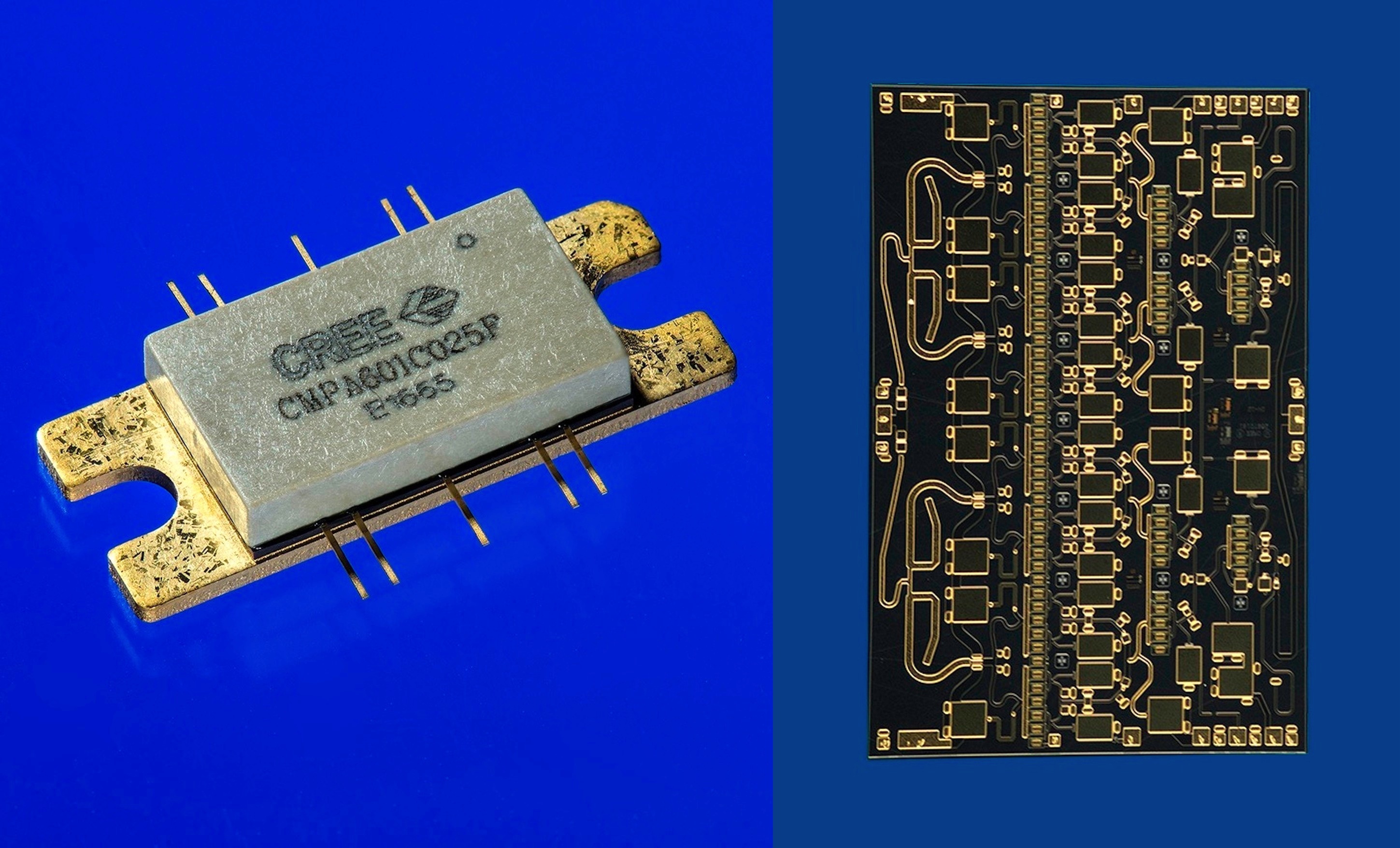
Key Applications of MMIC RF Power Amplifiers
These devices shine wherever you need clean, powerful RF amplification at microwave frequencies:
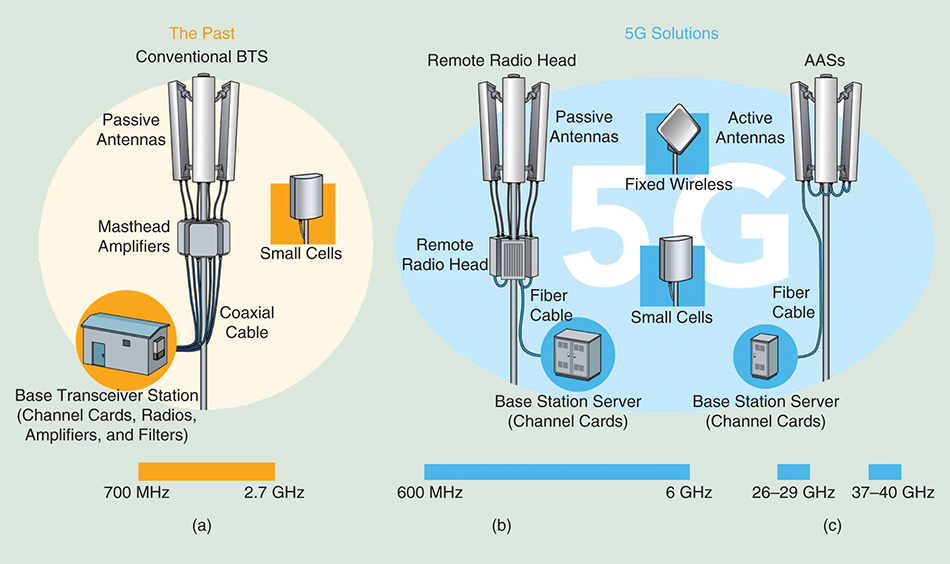
- 5G and 6G Infrastructure — Powering massive MIMO base stations and small cells with high linearity for complex modulations like 256-QAM.
- Radar and Electronic Warfare — Enabling compact phased-array radars for automotive, aerospace, and defense systems.
- Satellite Communications (Satcom) — Uplink amplifiers in ground terminals and onboard payloads where size, weight, and power (SWaP) are critical.
- Test & Measurement Equipment — Broadband drivers in signal generators and spectrum analyzers.
- Point-to-Point Microwave Links — Backhaul networks requiring wideband, high-efficiency amplification.
Why Choose MMIC Technology Over Discrete Designs?
- Miniaturization: Entire amplifier stages fit in a 3×3 mm die.
- Broadband Capability: Many cover multiple octaves without retuning.
- Thermal Efficiency: GaN variants offer high power-added efficiency (PAE) of 40–60%+.
- Cost at Scale: Once fabricated, MMICs are highly reproducible and economical in volume.
- Integration: Easy to combine with other MMIC functions like LNAs, switches, or phase shifters on the same board.
How to Select the Right MMIC RF Power Amplifier
When evaluating options, focus on these specs:
- Frequency Range — Match your band (e.g., 0.3–3 GHz, 1–18 GHz, or mmWave).
- Output Power — Look at P1dB (1 dB compression) or Psat (saturated power); common values range from 10 dBm to 50 dBm+.
- Gain — Typically 15–50 dB; higher gain reduces the need for driver stages.
- Efficiency (PAE) — Critical for battery or thermally limited systems.
- Linearity (OIP3, ACLR) — Essential for digital modulations.
- Packaging & Thermal — Bare die, QFN, or flange-mount with good heat sinking.
- Supply Voltage & Current — Compatibility with your system rails.
Always check datasheets for VSWR, noise figure (if applicable), and operating temperature range. Simulation tools like Keysight ADS or Cadence help validate integration.
A Reliable Choice for High-Performance Solutions
For engineers seeking proven, high-quality MMIC RF power amplifiers with broad frequency coverage and excellent specs, ZR Hi-Tech stands out as a strong manufacturer. Their lineup includes wideband options delivering up to 50 dBm output power and 50 dB gain across popular bands (0.3–6 GHz, 1–18 GHz, and beyond), backed by ISO-certified production and a focus on consistent RF performance. Whether you need off-the-shelf modules or custom designs, ZR's amplifiers deliver the reliability demanded by professional wireless and defense applications.
Implementation Tips for Best Results
- Thermal Management is crucial—use proper heat sinks or PCB copper pours.
- Bias Sequencing prevents device damage in GaN/GaAs parts.
- Input/Output Matching should be verified with a VNA.
- Power Supply Filtering minimizes noise injection.
Start with evaluation boards from the manufacturer to prototype quickly.
The Future of MMIC RF Power Amplifiers
With advances in GaN-on-SiC and InP processes, we're seeing higher efficiencies, wider bandwidths, and greater integration. Expect more smart MMICs with built-in power detectors, temperature compensation, and digital interfaces—perfect for adaptive 5G/6G and cognitive radar systems.
Ready to power up your next RF project? Explore the latest MMIC RF power amplifier options, run the numbers for your specific requirements, and partner with proven suppliers like ZR Hi-Tech for components that perform when it counts.
Have questions about your design or want to share your experiences with MMIC amplifiers? Drop a comment below—I'd love to hear from fellow RF enthusiasts!


Comments
Post a Comment