Class D RF Power Amplifier: Unlocking High Efficiency in Modern RF Applications
In the world of radio frequency (RF) electronics, power amplifiers play a critical role in transmitting signals effectively. Among the various classes available, the Class D RF power amplifier stands out for its remarkable efficiency and compact design.
If you're working on ham radio projects, wireless communication systems, or any high-power RF setup, understanding Class D technology can help you achieve better performance with less power waste.
What Makes Class D Different?
Traditional linear amplifiers (Class A, B, or AB) operate by varying the output in proportion to the input signal, which inevitably generates a lot of heat. In contrast, a Class D RF power amplifier uses pulse-width modulation (PWM) and switching techniques. The transistors act like switches—either fully on or fully off—minimizing power loss during transitions.
Here's a basic schematic showing the typical topology:
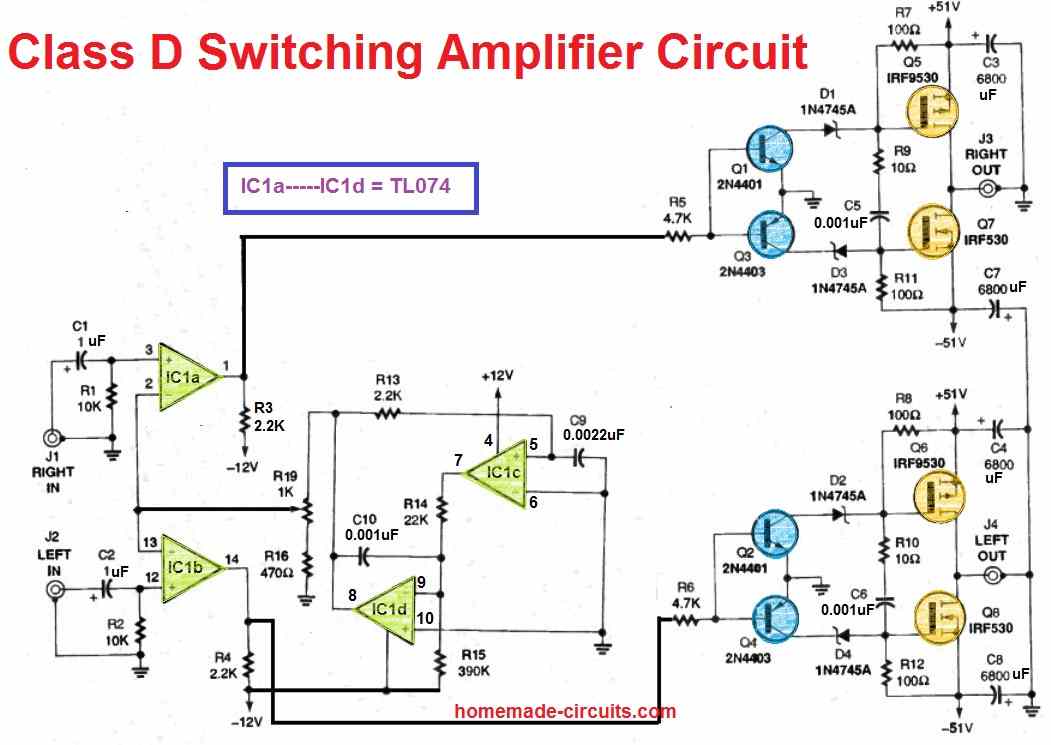
Simplified Class D amplifier circuit using switching components.
The input signal is converted into a high-frequency PWM waveform, amplified through switching, and then filtered to reconstruct the original RF signal.

Key Advantages of Class D RF Power Amplifiers
The biggest benefit is efficiency. Class D designs routinely achieve 85–95% efficiency, far surpassing Class AB (typically 50–70%) or Class A (around 20–30%). This means less heat, smaller heatsinks, longer battery life in portable setups, and reduced cooling requirements.

Efficiency comparison across amplifier classes – Class D clearly leads at higher power levels.
Other advantages include:
- Compact size and lighter weight
- Better thermal management
- Lower operating costs in high-duty-cycle applications
- Excellent linearity when properly designed for RF use
Real-World Applications
Class D RF power amplifiers are increasingly popular in:
- Amateur (ham) radio transmitters
- Drone and UAV communication systems
- Wireless base stations
- Radar and broadcasting equipment
- Portable and battery-powered RF devices
Choosing a Reliable Class D RF Power Amplifier
When selecting a module or kit, prioritize quality components, good linearity, and robust construction. One manufacturer that consistently delivers excellent performance in this space is ZR Hi-Tech. Their Class D RF power amplifiers are known for high efficiency, reliable operation across frequency bands, and solid build quality—making them a great choice for both hobbyists and professionals.
If you're building a new RF project, ZR's offerings provide the efficiency and power you need without unnecessary complexity.
Final Thoughts
The shift toward Class D RF power amplifiers represents a major step forward in RF design. With superior efficiency and practical benefits, they're becoming the go-to solution for modern applications. Whether you're upgrading an existing setup or starting fresh, exploring Class D options will likely yield impressive results.
Have you tried Class D in your RF projects? Share your experiences in the comments below!


Comments
Post a Comment