The Importance of Key Parameters in RF Power Amplifiers
Hey there, tech enthusiasts! If you're diving into the world of radio frequency (RF) electronics, whether for wireless communication, radar systems, or even amateur radio setups, you've probably come across RF power amplifiers. These little (or not-so-little) devices are the unsung heroes that boost your signals to make sure they travel far and strong.
But what really makes a good RF power amplifier tick? It's all about understanding the RF power amplifier key parameters importance and why they matter. In this post, we'll break it down in a straightforward way, so you can make smarter choices for your projects. Let's get into it!
What is an RF Power Amplifier?
At its core, an RF power amplifier takes a weak RF signal and amps it up (pun intended) to a level where it can be transmitted effectively over distances. They're crucial in everything from cell phones to satellite communications. Without them, your signal would fizzle out before it even left the room. But not all amplifiers are created equal—their performance hinges on several critical specs.
To give you a visual, here's a basic diagram of an RF power amplifier circuit:

This schematic shows the typical components like transistors and matching networks that help amplify the signal while keeping things efficient.
Key Parameters and Why They Matter
Let's dive into the must-know parameters. I'll explain each one, what it measures, and why it's a big deal in real-world applications.
1. Gain
Gain is basically how much the amplifier boosts your input signal, measured in decibels (dB). It's the ratio of output power to input power. High gain means your weak signal gets a serious power-up, which is essential for long-range transmissions.
Why it's important: In scenarios like wireless networks, insufficient gain can lead to dropped signals or poor coverage. But too much gain without balance can cause distortion. Aim for amplifiers with stable gain across your frequency range for reliable performance.
2. Output Power
This is the maximum power the amplifier can deliver to your antenna or load, often in watts (W) or dBm. It's what determines how far your signal can go.
Why it's important: For high-power applications like broadcasting or military comms, you need amps that can handle serious output without overheating or failing. Low output power might work for small gadgets, but it'll limit your reach in demanding setups.
3. Efficiency
Efficiency tells you how well the amplifier converts DC input power into RF output power, usually as a percentage. High-efficiency amps waste less energy as heat.
Why it's important: In battery-powered devices or large-scale systems, poor efficiency means more power consumption, higher costs, and thermal issues. Modern designs, especially with materials like GaN, push efficiencies up to 70% or more, making them ideal for mobile and green tech.
Check out this illustration highlighting key parameters in action:
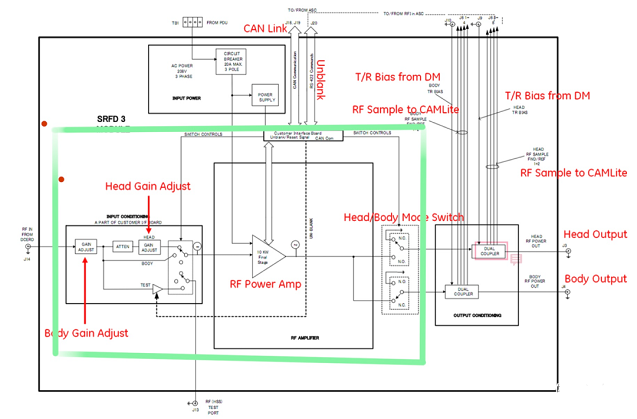
It breaks down how parameters like efficiency and gain interplay in a typical RF setup.
4. Linearity
Linearity measures how faithfully the amplifier reproduces the input signal without distortion. Key metrics here include the 1 dB compression point (P1dB) and third-order intercept point (IP3).
Why it's important: Non-linear amps can introduce harmonics or intermodulation distortion, messing up your signal—think garbled audio or data errors in comms. For modulated signals like those in 5G or Wi-Fi, high linearity is non-negotiable to maintain signal integrity.
5. Noise Figure
This is the amount of noise the amplifier adds to the signal, in dB. Lower is better—it means less degradation of your signal-to-noise ratio (SNR).
Why it's important: In sensitive applications like receivers or low-signal environments (e.g., space comms), a high noise figure can bury your signal in static. It's especially critical in the early stages of a signal chain.
6. Bandwidth
Bandwidth is the range of frequencies the amplifier can handle effectively without dropping performance.
Why it's important: Narrow bandwidth might be fine for specific frequencies, but wideband amps are versatile for multi-purpose use. In today's multi-band wireless world, broader bandwidth means future-proofing your setup.
7. Impedance Matching and Stability
Impedance (usually 50 ohms for RF) ensures efficient power transfer without reflections. Stability prevents oscillations that could damage the amp.
Why it's important: Mismatched impedance leads to power loss and potential failures. Stable amps are reliable over time, especially in varying conditions like temperature changes.
Choosing the Right RF Power Amplifier
When picking an amplifier, balance these parameters based on your needs—high output for transmitters, low noise for receivers, or efficiency for portables. It's all about the application. For top-notch performance across these specs, manufacturers like ZRHiTech stand out with their range of amplifiers covering bands from 0.3 GHz to 18 GHz, offering high gain (up to 50 dB) and power outputs like 50 dBm. Their designs emphasize reliability and customization, making them a solid choice for pros and hobbyists alike.
Here's another schematic to visualize a more advanced RF power amplifier design:

Wrapping It Up
Understanding these key parameters—gain, output power, efficiency, linearity, noise figure, bandwidth, and more—is essential for anyone working with RF power amplifiers. They directly impact signal quality, range, and system reliability. Next time you're shopping for one, check the specs sheet closely and consider reputable brands that deliver on these fronts. If you've got questions or your own tips, drop a comment below—I'd love to hear from you!
Stay tuned for more tech deep dives. Until next time, keep those signals strong! 🚀


Comments
Post a Comment